The stack
A purpose-built Vision AI system that delivers hyper-local sorting guidance, frictionless and energy-efficient by design — using intelligent caching to reduce the AI footprint of every scan.
Architecture
POUBELLE.AI runs on AWS, the world's leading cloud platform — ensuring bank-level security, 99.9% uptime, and the capacity to scale nationally without slowing down.
The POUBELLE.AI API connects to existing fleet management systems, operations platforms, and partner dashboards — no rip-and-replace required.
Avg. response time
from photo tap to bin answer
< 2s
Expected recognition accuracy
based on smartphone-camera Vision AI benchmarks
>90%
1Local rules coverage
local rules alignment for covered areas
100%
Expected sorting guidance accuracy
based on real-world multi-environment studies
>92%
2Languages supported
English and Spanish at launch
EN / ES
Deployment method
QR: Quick Response code · NFC: Near Field Communication
using existing bins, no heavy investment and no maintenance
QR / NFC
Sources
1 Recognition accuracy: DeepWaste mobile app, ResNet-50 on consumer smartphone photos, 88–93% precision (arxiv.org/abs/2101.05960); WasteNet edge-optimized model, 97% on TrashNet dataset (arxiv.org/pdf/2006.05873).
2 Sorting guidance accuracy: CNN waste classification across four real-world environments, ACM 2024 (dl.acm.org/doi/10.1145/3759023.3759127); EfficientNetV2-S benchmark, Nature Scientific Reports 2025 (nature.com/articles/s41598-025-08461-w).
Vision AI Layer
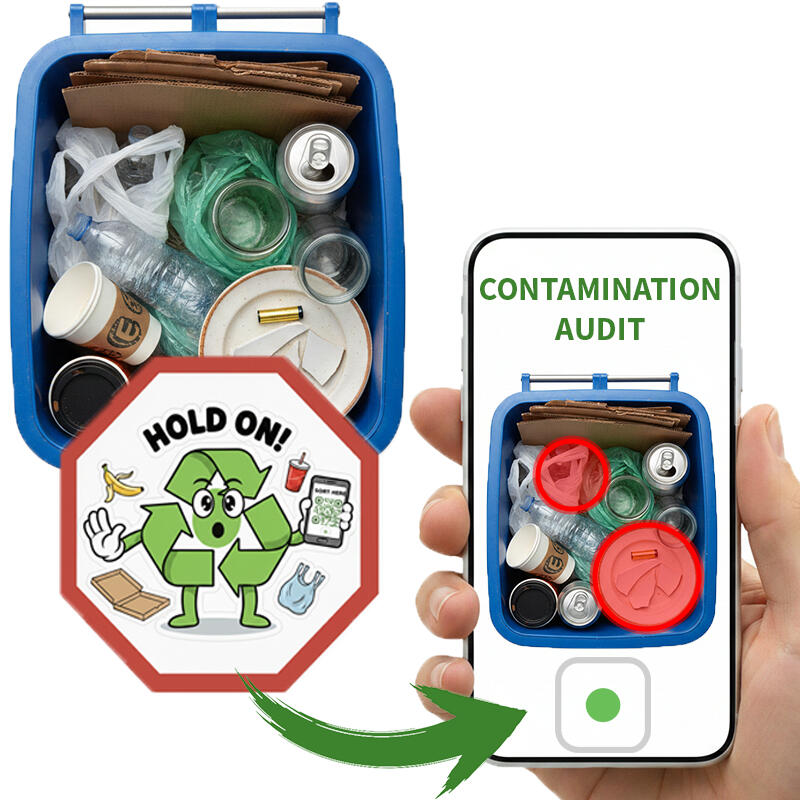
POUBELLE.AI's Vision AI processes a single smartphone image against a continuously updated database of local detailed rules. The result is a precise, actionable answer — not a generic guess.
Material Recognition
Identifies plastics, glass, paper, metal, organics, and hazardous materials from a single smartphone photo.
Contamination Scoring
Generates a contamination rate for each load, identifying the specific items driving rejection risk.
Sub-2-Second Response
Optimized inference pipeline returns a structured result — bin assignment, preparation steps, and context — in under 2 seconds.
Multi-Language Output
Delivers guidance in the user's preferred language. No translation friction at the moment of sorting.
Carbon Intelligence
A single POUBELLE.AI scan emits roughly 0.2 to 1 gram of CO₂ — lightweight image recognition. Recycling one aluminum can instead of landfilling it saves 98.7 grams. One correct sort can offset its own carbon cost — 100 times over.
One POUBELLE.AI scan
Lightweight image recognition. Optimized for mobile, further reduced by response caching.
~0.2–1g
CO₂ per scan 1
One correct sort can offset its own carbon cost — 100 times over.
| Item | If sorted correctly | CO₂ saved | Scans offset |
|---|---|---|---|
| Aluminum can | Recycled | saves 98.7g CO₂2 | 100–500× |
| Plastic bottle (500ml) | Recycled | saves ~50g CO₂3 | 50–250× |
| Apple core (40g) | Composted, not landfilled | saves ~280g CO₂e4 | 280–1,400× |
Response Caching
Common items answered from memory, not recomputed.
Once POUBELLE.AI's Vision AI has classified an item — a yogurt cup, a pizza box, a cardboard sleeve — that answer is cached. The next person who scans the same item gets an instant response pulled from memory, not a new AI inference cycle. This is how the ∼0.2–1g per scan figure holds even as usage scales.
Sources
1 AI inference energy use: Hao et al., 2024; lightweight mobile model quantization reduces resource use by up to 75% (arXiv).
2 Aluminum Association / Sphera, Life Cycle Assessment of North American Aluminum Cans, 2021 (aluminum.org).
3 Thunder Said Energy, CO₂ savings from PET bottle recycling, 500ml LCA, 2024 (thundersaidenergy.com).
4 EPA, "Quantifying Methane Emissions from Landfilled Food Waste," 2023 (epa.gov); Scientific Reports 2023, composting emissions study (nature.com/srep).
Sorting Rules Engine
Waste sorting rules are hyperlocal and evolve. POUBELLE.AI maintains a continuously synchronized database of what the Material Recovery Facilities (MRF) actually accept.
| City | Item | POUBELLE.AI Answer | How / Why |
|---|---|---|---|
| Boulder, CO | Greasy pizza boxes | Split: grease → landfill, clean cardboard → recycling | Tear the box apart — greasy sections landfill, unsoiled sections recycled as cardboard |
| Denver, CO | Greasy pizza boxes | If soaked through both sides: trash or home/garden composting | Grease saturating both sides makes cardboard non-recyclable — trash it or compost at home |
| Boulder, CO | Black plastic containers | Curbside Recycling | Boulder accepts black plastic containers in curbside recycling |
| San Francisco, CA | Black plastic containers | Landfill | Same optical sorting limitation |
Roadmap
The core web-app experience designed for zero-friction engagement at the physical bin.
The backend engines that prove value to municipalities, partners, and haulers.
Transitioning casual scanners into recurring, brand-loyal users.
The scale phase where POUBELLE.AI becomes the ambient intelligence for circularity.
The Development Team
We are proud to be developed & maintained by Zeb, a global leader in AI-powered transformation and an AWS Premier Tier Partner.
With a team of over 1,500 technologists and a 2024 AWS Partner of the Year distinction, Zeb provides the high-velocity engineering and advanced AI expertise required to make POUBELLE.AI a world-class sorting tool. You can learn more about their digital transformation journey at zeb.co.
Team size
1,500+
technologists worldwide
AWS status
Premier
Tier Partner
Recognition
2024
AWS Partner of the Year
Platform
AWS
99.9% uptime, bank-level security